

Dental Implant Surgical Guides: The Complete Guide to Guided Implant Surgery, Navigation, and Irrigation-Integrated Technology
Page Contents
ToggleIntroduction
Dental implant surgical guides have transformed modern implant dentistry by improving accuracy, predictability, and restorative outcomes. What was once a procedure heavily dependent on clinical experience and freehand judgment has evolved into a digitally driven workflow that allows clinicians to virtually plan implant placement before surgery ever begins.
Today, guided implant surgery is widely used for single tooth replacement, multiple implant restorations, full-arch implant reconstruction, and complex bone reduction procedures. Through the use of cone beam computed tomography (CBCT), intraoral scanning, digital treatment planning software, and 3D printed surgical guides, clinicians can place implants with a level of precision that was previously impossible.
Despite these advances, important differences exist among the various types of dental implant surgical guides available today. Static surgical guides, dynamic navigation systems, tooth-supported guides, mucosa-supported guides, bone-supported guides, and stackable guide systems each offer unique advantages and limitations. More recently, a new category of guided surgery has emerged that addresses one of the most overlooked aspects of implant surgery: irrigation and osteotomy cooling.
This comprehensive guide explores the major categories of dental implant surgical guides, reviews their benefits and limitations, discusses the role of guided implant surgery in modern dentistry, and examines how irrigation-integrated surgical guides are helping address concerns related to thermal bone injury, bone necrosis, and long-term implant success.
What Are Dental Implant Surgical Guides?
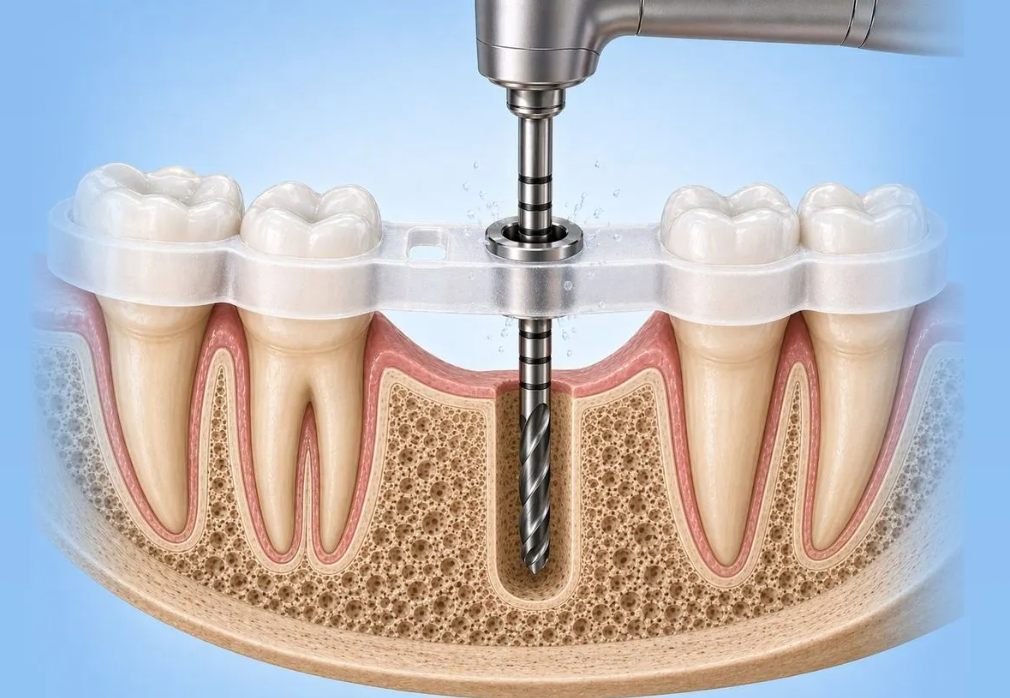
Dental implant surgical guides are custom-fabricated devices designed to transfer a virtual implant treatment plan directly to the patient during surgery. These guides are created using data obtained from CBCT scans, intraoral scans, digital wax-ups, and restorative treatment planning software. The resulting guide controls implant angulation, depth, and position to help ensure that the final implant placement matches the intended prosthetic outcome.
The primary goal of guided implant surgery is not simply to place implants in bone. Modern implant treatment is prosthetically driven, meaning implant position is determined by the desired restorative result. Surgical guides allow clinicians to visualize and plan implant placement relative to future crowns, bridges, implant-supported dentures, and full-arch prostheses before surgery begins.
This integration of surgical and restorative planning has helped improve treatment predictability while reducing the risk of prosthetic compromises, anatomical complications, and implant positioning errors.
The Evolution of Guided Implant Surgery
For many years, dental implants were placed primarily using freehand techniques. Surgeons relied on clinical experience, radiographs, diagnostic models, and intraoperative judgment to determine implant position. While highly skilled clinicians can achieve excellent outcomes using freehand methods, treatment results are often more dependent on operator experience and can vary significantly from case to case.
The introduction of CBCT technology fundamentally changed implant treatment planning. Three-dimensional imaging allowed clinicians to evaluate bone volume, identify critical anatomical structures, and assess restorative requirements with unprecedented accuracy. As digital planning software evolved, it became possible to virtually position implants within the patient’s anatomy and then fabricate a guide capable of transferring that plan directly to the surgical site.
Today, guided implant surgery has become a standard component of modern implant dentistry. The technology continues to evolve as clinicians seek greater accuracy, improved efficiency, enhanced safety, and better long-term outcomes.
Static Surgical Guides: The Most Common Form of Guided Implant Surgery
Static surgical guides represent the most widely utilized form of guided implant surgery. A static guide is designed and manufactured before surgery based upon a finalized digital treatment plan. During the procedure, drills pass through guide sleeves or guide channels that physically direct the osteotomy according to the approved plan.
One of the primary advantages of static surgical guides is their simplicity. Once the guide is seated, implant positioning is largely controlled by the guide itself. This allows clinicians to consistently reproduce the planned implant position while minimizing surgical variability.
Static guides are highly effective for single implants, multiple implants, immediate implant placement, full-arch rehabilitation, and complex restorative-driven treatment plans. They generally require less equipment investment than dynamic navigation systems and have a shorter learning curve for most clinicians.
However, static guides also have limitations. Because the guide is manufactured before surgery, significant changes cannot easily be made during the procedure. Surgical visibility may be reduced, access can become restricted in posterior regions, and irrigation delivery may be compromised by guide sleeves and guide body geometry. These irrigation limitations have become increasingly important as research continues to demonstrate the effects of excessive heat generation during osteotomy preparation.
Dynamic Navigation Systems
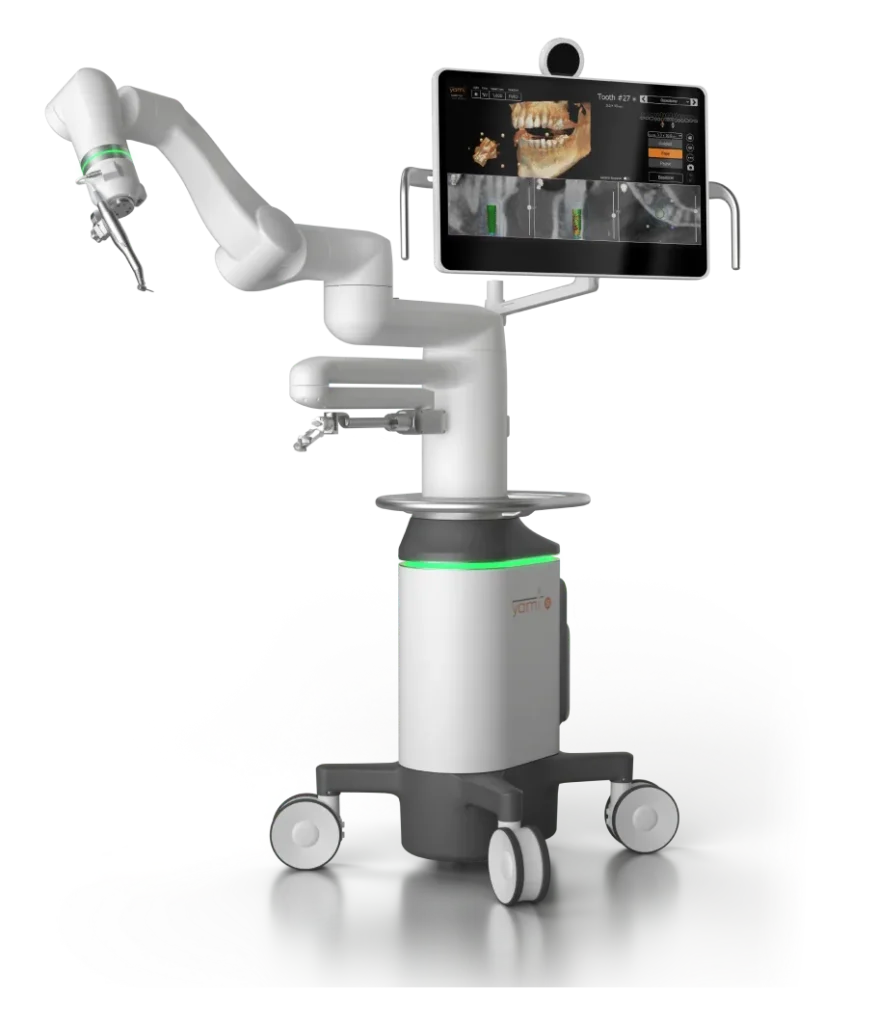
Dynamic navigation systems provide an alternative approach to guided implant surgery. Rather than using a physical guide, navigation systems utilize cameras, tracking devices, and real-time software to monitor drill position throughout the surgical procedure.
Often compared to a GPS navigation system, dynamic guidance allows clinicians to visualize the location, angulation, and depth of the drill on a computer monitor while operating. Because there is no physical guide controlling the drill path, adjustments can be made during surgery while still maintaining awareness of the planned implant position.
Dynamic navigation offers exceptional flexibility and may improve visibility in certain clinical situations. It is particularly valuable when treatment plans require modification after surgery has begun or when anatomical conditions differ from what was anticipated during planning.
The primary limitations of dynamic systems include higher costs, increased equipment requirements, more extensive training, and greater workflow complexity. While navigation systems can provide excellent accuracy, they are often associated with a steeper learning curve than traditional static guides.
Tooth-Supported Surgical Guides
Tooth-supported surgical guides are generally considered the most accurate type of static guide because they seat on stable natural teeth. The rigid support provided by existing dentition minimizes movement and helps ensure highly reproducible guide positioning.
These guides are frequently utilized for single implants and partially edentulous patients where sufficient teeth remain to support the guide. Because seating is typically straightforward and highly predictable, tooth-supported guides often achieve excellent accuracy with minimal positioning variability.
The primary limitation is that they can only be used when adequate natural dentition is present. As patients become increasingly edentulous, alternative guide support mechanisms must be considered.
Mucosa-Supported Surgical Guides
Mucosa-supported guides are commonly used for fully edentulous patients and All-on-X implant procedures. These guides rest directly on soft tissue and are often stabilized with fixation pins during surgery.
One advantage of mucosa-supported guides is that they can facilitate flapless implant placement in appropriately selected patients. By avoiding extensive flap reflection, clinicians may reduce surgical morbidity and improve postoperative comfort.
However, soft tissue compressibility can introduce variability that does not exist with tooth-supported guides. Careful verification of guide seating and fixation pin placement are essential to maximize surgical accuracy.
Bone-Supported Surgical Guides
Bone-supported guides are typically utilized when flap reflection is required. These guides seat directly on exposed alveolar bone and are frequently used in advanced implant reconstruction procedures, including bone reduction and full-arch rehabilitation.
Bone-supported guides allow direct visualization of the surgical field while maintaining control over implant positioning. They are particularly valuable when significant alveolar reduction is necessary or when anatomical modifications must be performed before implant placement.
Although highly effective, bone-supported workflows generally involve greater surgical complexity and more extensive tissue reflection than tooth-supported or mucosa-supported approaches.
Stackable Surgical Guide Systems
Stackable surgical guide systems have become increasingly popular in full-arch implant reconstruction. Rather than relying on a single guide throughout surgery, multiple guides are used sequentially to maintain accuracy during each phase of treatment.
A typical stackable workflow may begin with a fixation pin guide followed by a bone reduction guide and ultimately a fully guided implant osteotomy guide. This approach allows clinicians to establish a precise surgical reference that remains consistent throughout the procedure.
Stackable systems can improve predictability in complex full-arch cases and help ensure that bone reduction, implant placement, and restorative positioning remain coordinated. As digital workflows continue to evolve, stackable guide systems are becoming increasingly common in advanced implant dentistry.
The Hidden Limitation of Conventional Surgical Guides: Irrigation
Although implant guide technology has advanced significantly, one critical challenge has received relatively little attention. Many conventional surgical guides partially obstruct external irrigation during osteotomy preparation.
As implant drills rotate through bone, friction generates heat. External saline irrigation is intended to cool both the drill and surrounding bone tissue. However, guide sleeves and surrounding guide structures can restrict saline flow and reduce cooling efficiency at the exact location where heat is being generated.
This issue is frequently overlooked because the guide itself may appear to be functioning properly. Implant positioning accuracy may be excellent while irrigation access remains compromised. As a result, clinicians may unknowingly increase the potential for elevated bone temperatures during osteotomy preparation.
Thermal Bone Injury and Bone Necrosis
The biological consequences of excessive heat generation during implant surgery have been documented for decades. Research has demonstrated that prolonged exposure to temperatures above approximately 47°C can damage bone cells and impair normal healing.
Thermal injury may contribute to delayed osseointegration, compromised bone vitality, and increased risk of implant complications. In severe cases, excessive heat generation can result in thermal bone necrosis, a condition characterized by irreversible damage to surrounding bone tissue.
While multiple factors influence heat generation, irrigation efficiency remains one of the most important variables under the clinician’s control. For a comprehensive discussion of thermal injury and implant surgery, read our companion guide on Bone Necrosis During Dental Implant Surgery.
Irrigation-Integrated Surgical Guides: A New Category of Guided Surgery
The growing awareness of osteotomy cooling challenges has led to the development of irrigation-integrated surgical guides. Unlike traditional static guides that may restrict saline delivery, irrigation-integrated guides are specifically engineered to direct irrigation toward the osteotomy throughout the drilling sequence.
This technology represents a significant evolution in guided implant surgery because it addresses both implant positioning accuracy and biological preservation simultaneously. Rather than treating guidance and irrigation as separate considerations, irrigation-integrated systems combine both functions into a single workflow.
The goal is straightforward: maintain the precision benefits of guided implant surgery while improving cooling efficiency and reducing the risk of excessive heat generation.
The Patented IrriGUIDE® Technology Platform
IrriGUIDE® technology was developed specifically to address the irrigation limitations associated with conventional static surgical guides. Through a patented irrigation delivery system, dedicated channels are incorporated directly into the surgical guide design to direct saline toward the active osteotomy site.
This approach creates a true irrigation-integrated surgical guide rather than relying solely on traditional external irrigation. By delivering cooling fluid directly where it is needed most, IrriGUIDE technology helps clinicians maintain the advantages of guided implant surgery while improving irrigation access during osteotomy preparation.
IrriGUIDE® irrigation-integrated surgical guides represent a distinct category of implant guide technology. Because the technology is protected by patent rights, IrriGUIDE Lab is the only laboratory authorized to manufacture genuine IrriGUIDE irrigation-integrated surgical guides utilizing this patented system.
The IrriGUIDE Adapter: Retrofitting Existing Surgical Guides
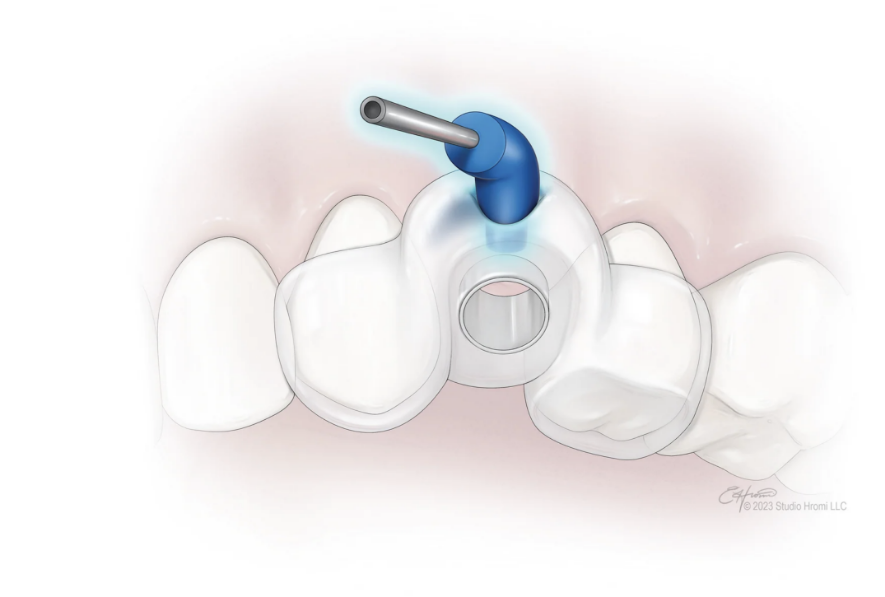
Recognizing that many clinicians and laboratories already utilize established guided surgery workflows, the IrriGUIDE Adapter was developed as a retrofit solution. The adapter allows compatible conventional surgical guides to be converted into irrigation-integrated surgical guides without requiring an entirely new surgical system.
By incorporating a dedicated irrigation port into existing guide designs, clinicians can enhance saline delivery while continuing to utilize familiar implant systems, guided surgery kits, and laboratory workflows. The IrriGUIDE Adapter provides an effective bridge between traditional guided surgery and next-generation irrigation-integrated implant guidance.
For clinicians who already design or purchase conventional static surgical guides, the IrriGUIDE Adapter offers a practical way to add irrigation-integrated functionality without changing existing treatment planning or manufacturing processes. To learn more about the technology, compatible guide systems, and how the adapter can be incorporated into your workflow, visit the IrriGUIDE Adapter website. The site includes detailed information on the patented technology, clinical applications, and retrofit solutions available for guided implant surgery.
Surgical Guide Accuracy and Long-Term Implant Success
The benefits of guided implant surgery extend beyond surgical convenience. Accurate implant positioning influences restorative design, cleansability, biomechanics, esthetics, and long-term maintenance.
Poor implant positioning can create restorative contours that trap plaque and make oral hygiene more difficult. Over time, these conditions may contribute to peri-implant mucositis and peri-implantitis. Consequently, the relationship between surgical planning and long-term biological health is far more significant than many clinicians realize.
Modern implant treatment planning should therefore focus not only on implant placement accuracy but also on creating restorations that support long-term maintenance and peri-implant health.
For a deeper discussion of implant disease and maintenance considerations, visit our companion guide on Peri-Implantitis: Causes, Prevention, and Treatment.
The Future of Dental Implant Surgical Guides
The future of guided implant surgery will likely focus on three primary objectives: greater accuracy, improved efficiency, and enhanced biological outcomes. Static guides will continue to play a dominant role because of their simplicity and predictability. Dynamic navigation systems will continue expanding into advanced surgical applications. At the same time, irrigation-integrated technologies are expected to gain increasing attention as clinicians recognize the importance of osteotomy cooling and bone preservation.
As implant dentistry evolves, success will increasingly be defined not only by where implants are placed, but also by how effectively clinicians preserve the biology that supports them. Technologies that improve implant accuracy while simultaneously reducing thermal risk may represent the next major advancement in guided implant surgery.
Conclusion
Dental implant surgical guides have transformed modern implant dentistry by improving accuracy, predictability, and restorative outcomes. Static surgical guides, dynamic navigation systems, tooth-supported guides, mucosa-supported guides, bone-supported guides, and stackable workflows each play important roles in contemporary implant treatment.
However, conventional guided surgery systems have historically overlooked one critical factor: irrigation efficiency during osteotomy preparation. As awareness of thermal bone injury and bone necrosis continues to grow, irrigation-integrated surgical guides represent an important advancement in guided surgery technology.
Through patented irrigation-integrated surgical guide technology and the innovative IrriGUIDE Adapter retrofit system, IrriGUIDE Lab has pioneered a new category of guided implant surgery designed to combine precision implant placement with enhanced irrigation delivery. The result is a surgical workflow focused not only on implant accuracy, but also on preserving the biology necessary for long-term implant success.